
Reading time: 5 minutes.
If you only remember one thing, remember this:
Building a brand isn’t just about having a pretty logo, racking up sales, and hitting the million mark. It’s about choosing, every day, where you put your energy, what you let go of, and who you invite to join you for a part of the journey.
What if building a brand were, first and foremost, the act of bringing your ideal world to life?
I think we can all agree that we’re collectively developing an aversion to traditional marketing rhetoric.
When we talk about “building a brand,” most entrepreneurship guides and top LinkedIn experts give us the same cookie-cutter formula: market research, targeting pain points, conversion funnels, and optimizing customer lifetime value (LTV). In short, we’re constantly told that branding is primarily about “convincing people to buy.”
And let’s be clear: these stereotypes aren’t wrong, and are even quite interesting, but they’re also dangerously incomplete.
By reducing brand creation to a series of persuasion techniques, we lose sight of the beating heart of the project. A brand isn’t just marketing packaging. It’s the embodiment of a worldview. It’s saying out loud, in front of everyone:
“Here is the ideal world I’d like to build, here are the rules of the game we could write together, and here’s the plan to get there.”
What’s the difference between a brand’s vision and its business strategy?
To me, one of the biggest pitfalls in the world of entrepreneurship today is an almost obsessive and suffocating fixation on financial goals, at the expense of staying grounded in real-life.
If you create a brand solely to “sell more” or “get rich” (I can see you million-chasing startuppers), every decision becomes a stressful transaction. But if the business becomes merely a “means” to achieve your goals or your vision of an ideal world, then every decision is simply a new path to explore on the way to your destination, and your daily work finally regains its true value and meaning.
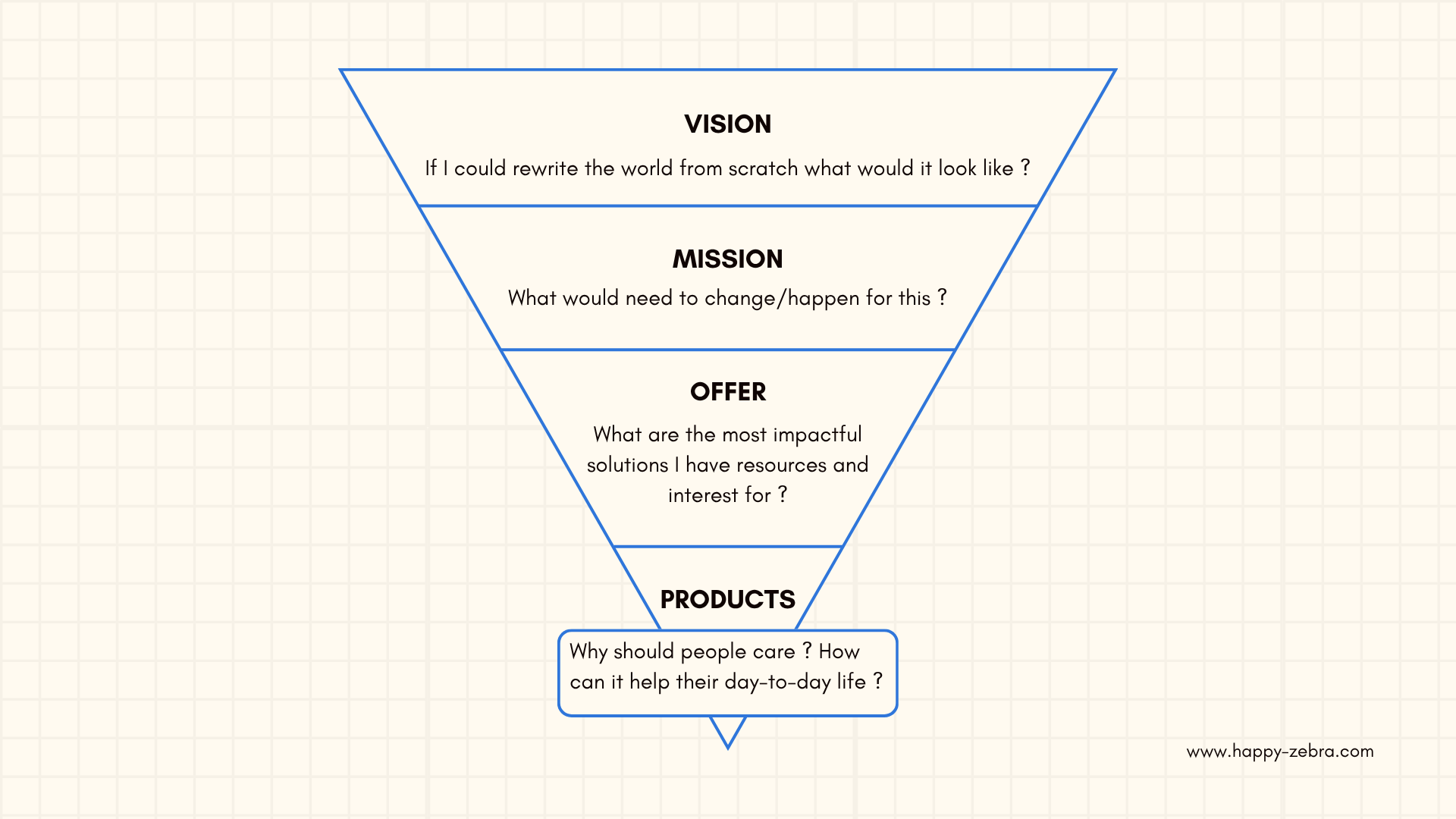
A vision without a business strategy is nothing more than a nice story. But a business strategy without a vision is nothing more than a nice car with no engine.
⚡ Exercise
Duration: 2 minutes.
Grab a piece of paper or open a note on your phone and answer this one question:
“If my company achieved all its financial goals tomorrow, but my daily life remained exactly the same as it is today, would I be happy to wake up tomorrow morning?”
If the answer is no, it’s not your sales strategy that needs to be revisited first, it’s your worldview.
How Can I Use Worldbuilding to Create My Brand Identity ?
In Fundamentals of Game Design, designer Ernest Adams explains that the designer’s role is to create a fictional world that players can experience firsthand through visuals, music, interfaces, and a distinctive artistic direction. And as is often the case in design, what applies to one field can be applied to many others.
| Video Game Feature | Brand Identity Feature | Role & Impact on the Experience |
|---|---|---|
| Art Direction & Graphics | Brand Guidelines & Visuals | Define the overall atmosphere, colors, typography, symbolism, and visual style |
| User Interface (UI) | Customer Experience (CX) | Ensure smooth navigation on the website, during onboarding, outboarding, in emails, and across all interactive platforms. |
| Soundscapes & Dialogue | Tone, Editorial Style & Sound Identity | Select vocabulary, language level, and sounds to create a recognizable sound signature. |
| Game Rules & Mechanics | Values, Business Model & Limits | Define what is permitted, encouraged, or strictly prohibited to achieve one's goal (ethics, pricing, exchange policy) |
| Quests & Goals | Offers, Journeys & Transformations | Provide the audience with clear steps to help them overcome challenges and progress toward their ideal world |
In fact, a brand operates on exactly the same principle. Creating a visual identity or a value proposition means giving tangible form to a vision. It means creating a space, virtual or real,where we’d like to live, and inviting others to settle there with us.
⚡ Exercise
Time: 3 minutes.
Complete these three simple sentences:
In the world I’m trying to build, people have the right to...
What you’ll never see in my brand is...
If my brand were a physical place, you’d feel...
Competition and Partnerships: How Do I Find My Place in the Market?
When a brand is built around a clear vision, the dynamics of prospecting change radically. We no longer “hunt” for customers, partners, or collaborations, we build a community around shared values.
In the collective imagination, the business world is a fierce battlefield where everyone fights for the same market share. But if we apply the theories of journey and experience design, this view is a misconception.
Competition exists only when two people have mutually exclusive goals (if one wins, the other must lose).
Cooperation occurs when people seek to achieve the same vision, or compatible goals, by joining forces.
True competition, in this sense, is therefore extremely rare.
For there to be direct competition between two brands, they would have to pursue two completely incompatible worldviews. However, aside from extreme cases, very few entrepreneurs launch a venture with the goal of making the world a sadder, poorer, or more chaotic place.
Deep down, most people share fairly similar desires for improvement, fulfillment, or simplification. Once you understand this, the economic landscape takes on a different face:
Potential partners with whom to collaborate to advance a shared vision more quickly.
Creators who are simply playing a different game, by their own rules and for an audience with different expectations.
Stopping to view the market as an arena allows you to approach partnerships with a sense of calm. Yesterday’s “competitors” become natural allies with whom to co-create events, cross-promote audiences, or combine expertise to advance a common cause. And those who don’t share your vision don’t detract from your work: they’re simply catering to people seeking a different life experience.
By sharing your dreams and your approach to your work, you create a natural filter:
People who don’t share your vision will move on (and that’s a great thing—it’ll save you time and energy)
People who share your aspirations immediately recognize this as their “home.”
Your business then becomes a way to nurture this network, fund new initiatives, and test concrete ideas and tools so you can move forward together.
⚡ Exercise
Duration: 3 minutes.
Identify a business in your industry whom you’ve previously considered a “competitor.”
Note the worldview they seem to champion, then find a joint action (a cross-industry workshop, co-created content, an exchange of resources) that would serve both their customers, your customers, and your combined visions.
How to Align Your Actions with Your Brand’s Vision?
An inspiring brand doesn’t just settle for stating its intentions on a pretty “About” page. No, we’ll leave the pretty promises with no action behind them to others. A truly inspiring brand, a true “champion” of a cause, demonstrates through its daily choices that a different way of operating is possible, right now.
For your future clients and partners, your brand must be living proof that a single person can already make a difference, and that, by extension, together, you could change the world.
By embodying these principles, your brand ceases to be just a logo or attractive packaging. It becomes a resource, a point of reference, and a guide for those who, too, wish to shape their own future.
⚡ Exercise
Duration: 3 minutes.
Write a short manifesto of 3 to 5 lines summarizing your brand’s vision, then share it with someone in your network or in your next post.
Building a brand isn’t about mechanically applying criteria to meet market expectations. You want to build a business that lasts and a life you love. So seize this opportunity to create a world where you, your loved ones, and your community will genuinely enjoy growing every day.
FAQ
-
That’s the first concern, and it’s 100% legitimate. Great question.
Having a vision doesn’t mean becoming a starved artist who refuses to sell. Business is the vehicle: it needs fuel (cash flow) to move forward. The idea isn’t to drop everything overnight, but to apply the 80/20 rule. Keep or launch very simple, reliable “bread-and-butter” opportunities that cover your daily expenses without draining all your energy, and use the remaining time to lay the foundation for your brand and your vision. Financial stability creates the peace of mind needed to build a world that’s in alignment with your vision.Besides, there’s nothing stopping you from launching your idea using a hybrid model when you’re just starting out. Having a second source of income or a part-time job can be a great way to give yourself the peace of mind and perspective you need to grow your business for the right reasons, and not just to survive, even if it might take a little longer!
-
Absolutely. Your “ideal world” doesn’t have to be a global revolution or a complex utopia. It can consist of very simple yet deeply meaningful things:
A world where children are delighted and excited to go to school
A world where everyone is accepted and respected just as they are, regardless of their differences
A world where everyone has access to water, shelter, and food.
Your ideal world is simply the environment in which you, your clients, and your loved ones feel comfortable, respected, and inspired. -
Yes, and that’s exactly the point. A brand that tries to please everyone ends up failing to capture anyone’s interest. By standing firm on what you believe in (and what you reject), you’ll deter “time-consuming” clients, those who haggle over prices or don’t respect your guidelines. In return, you’ll become the obvious choice for clients who share your values. You’re trading off low-value volume for high-quality relationships and perceived value.
-
Absolutely not.
Worldbuilding is an evolving process. Think of your current ecosystem as a house undergoing renovation: you can keep the solid foundation (your skills, your deliverables) and gradually adjust the decor.
Start by tweaking your tone in your next newsletter, clarifying your terms in your sales proposal, or realigning just one of your offerings. Every small adjustment brings you closer to your target audience. -
Don’t touch your website or your color scheme just yet.
Go back to basics: take 15 minutes to write your Micro-Manifesto.
Put in writing why you do this work, what you want to offer people, and what kind of experience you want them to have. Once you’ve written this down, all your future decisions about design, pricing, and content will become infinitely simpler. And if you’d like to discuss this and get some initial ideas for your vision and your business, the first consultation is free (and really helpful), you can book your slot right here: https://cal.com/solene-happy-zebra/free-1-hour-mentorship